
Service · Cokato, Minnesota
Tree Health and Risk Assessment in Central Minnesota
A tree health and risk assessment answers two separate questions about a tree on your property near Cokato or anywhere in our area: what is wrong with it, and is it likely to hurt something. Those are different questions with different answers, and a lot of trees get removed around here because nobody asked the first one properly.
What we look at
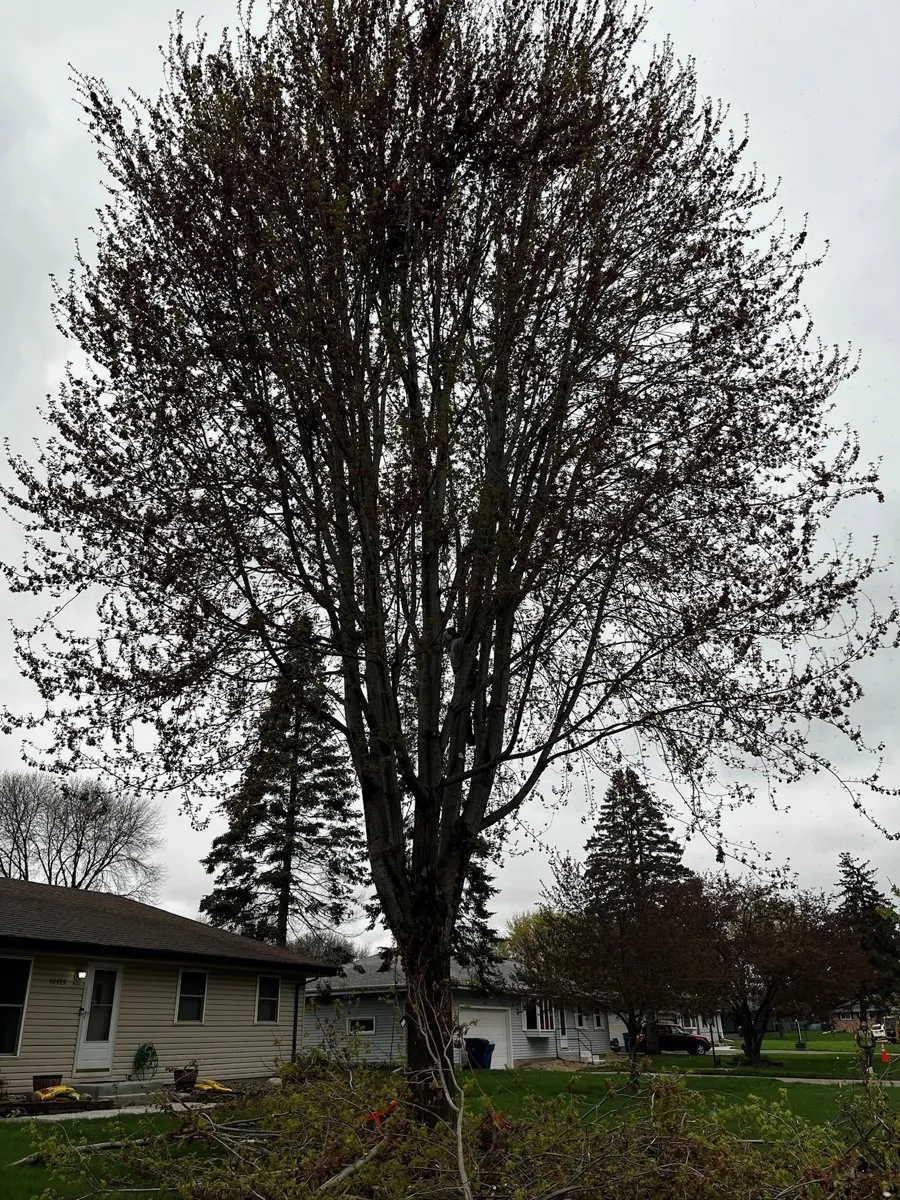
The assessment starts at the bottom, because that is where the failures that matter begin. We look at the root plate and the soil around it for cracking or heaving, at the root flare to see whether it is buried or girdled, and at the base of the trunk for cavities, soft wood and fruiting fungi. Then the trunk for splits, included bark and old wounds, then the unions where limbs attach, and finally the canopy for dieback pattern, which tells us a great deal about cause. Thinning that starts at the top means something different from thinning that starts on one side.
- Root plate and soil for cracking, heaving or recent movement
- Root flare for burial, girdling roots and decay at the base
- Trunk for cavities, splits, included bark and shelf fungi
- Branch unions, especially codominant stems with tight angles
- Canopy dieback pattern, which points at the cause
Diagnosis: what is actually killing it
Most of what we get called out for in this area comes down to a short list. Emerald ash borer on ash. Oak wilt, which moves through connected root systems and can take a group of oaks rather than one. Dutch elm disease, still working through the elms that came back after the first wave. Bronze birch borer on stressed white birch, which is why so many planted birch here struggle. And a great deal of simple drought and construction damage, which looks like disease and is not. Getting this right matters because the treatment for one is useless against another.
Risk depends on what is underneath the tree
A tree is only a hazard if there is something for it to hit. A hollow cottonwood in the middle of a pasture can stand for years and it does not matter much if it comes down. The same tree over a driveway where cars park is a different conversation. We look at the likelihood of failure, the size of the part likely to fail, and what is underneath it and how often. That last part is why two identical trees can get opposite recommendations.
What you get, and what happens next
You get a plain-language read on each tree we look at: what is wrong, how urgent it is, and the realistic options. Sometimes that is treatment. Often it is a pruning plan. Sometimes it is removal. And frequently it is to leave it alone and look again in two years, which is an answer we give more often than people expect from a company that makes its money cutting trees down.
What you get
- ISA Certified Arborist on site, not a guess from the driveway
- Diagnosis before any recommendation to cut
- Risk read that accounts for what is actually underneath the tree
- Plain-language explanation of the options and what each costs you
- Honest recommendation to do nothing when that is the right answer
- Useful documentation when a neighbor dispute or an insurer is involved
How the job runs
Where we do this work
Health & Risk Assessment is something we do right across our area, out of the shop in Cokato. The towns we are in most often:
- Health & Risk Assessment in Cokato
- Health & Risk Assessment in Dassel (5 miles from the shop)
- Health & Risk Assessment in Litchfield (17 miles from the shop)
- Health & Risk Assessment in Hutchinson (22 miles from the shop)
- Health & Risk Assessment in Annandale (14 miles from the shop)
- Health & Risk Assessment in Maple Lake (18 miles from the shop)
- Health & Risk Assessment in Howard Lake (7 miles from the shop)
- Health & Risk Assessment in Waverly (12 miles from the shop)