
Service · Cokato, Minnesota
Tree Trimming and Pruning in Central Minnesota
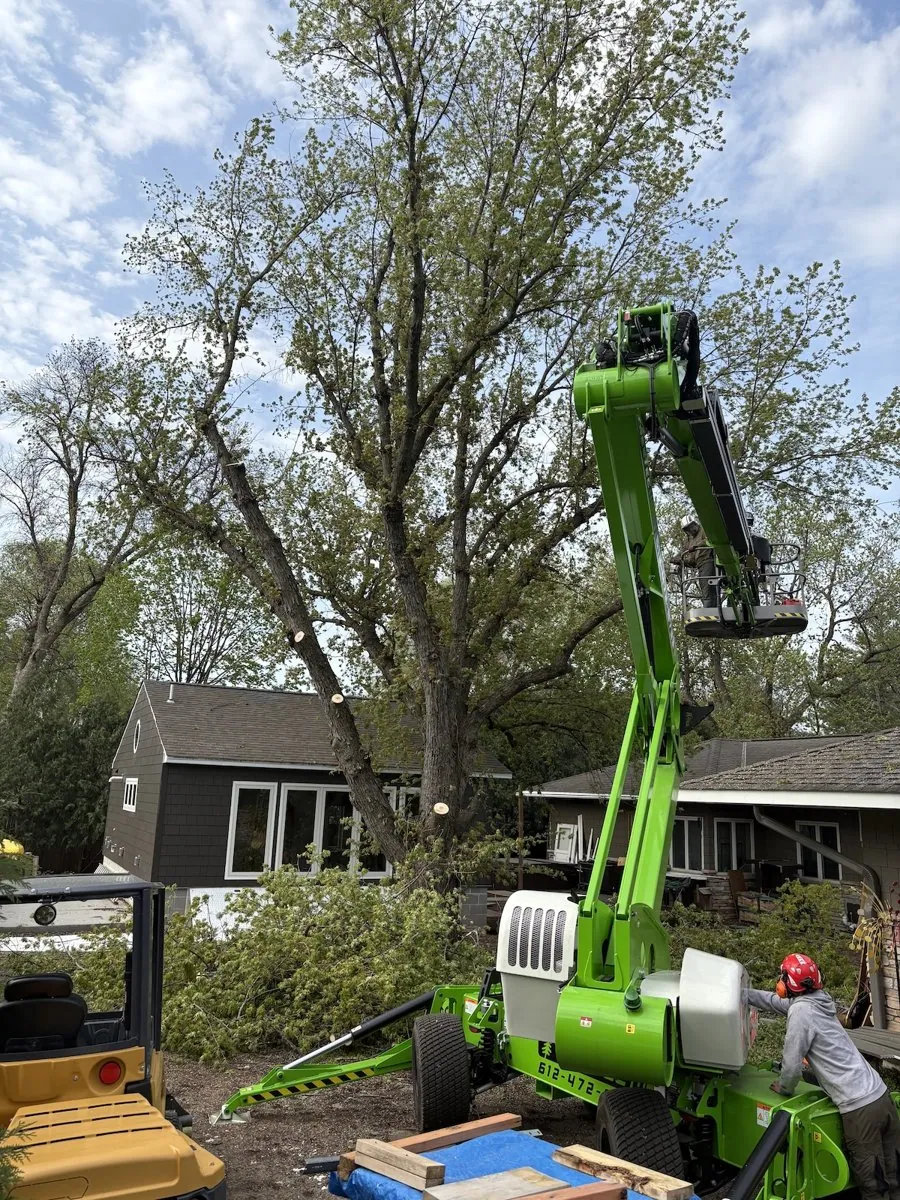
Tree trimming for homes and acreages around Cokato, Annandale and Litchfield covers a lot of ground, from getting limbs off a roof to restructuring a young tree so it does not become a problem in twenty years. The two things that matter most are when the cuts are made and where on the branch they land, and both of those get done wrong constantly.
When to prune, and the oak rule
For most trees here, the dormant season from late autumn through late winter is the best time. The tree is not actively growing, the structure is visible with the leaves off, and wounds close cleanly when growth restarts in spring. Oak is a firm rule rather than a preference. Do not prune oak between April and July. That is when the beetles that spread oak wilt are active and drawn to fresh wounds, and a single cut in the wrong month can introduce a disease that kills the tree and can move to neighboring oaks through connected roots. If an oak is damaged in that window and has to be cut, the wound gets sealed immediately, which is the one situation where wound paint is genuinely useful.
- Late autumn through late winter is best for most species
- Never prune oak April through July because of oak wilt
- Seal any unavoidable oak wound made in that window straight away
- Storm damage gets dealt with whenever it happens, season aside
- Spring-flowering trees are pruned after they bloom to keep the display
Thinning, raising and reduction
Crown thinning takes out crossing, rubbing and dead wood so wind moves through the canopy instead of pushing against it, which lowers the odds of losing a limb in a summer storm. Crown raising takes off the lowest limbs to get clearance over a drive, a walk or a roof. Crown reduction shortens the outer canopy where a tree has outgrown its spot, and it gets done by cutting back to a lateral branch that can take over as the new leader, never by simply shortening everything to a stub.
We do not top trees
Topping means cutting the main leaders back to stubs, and it is the most destructive thing routinely done to trees around here. It removes the leaf area the tree feeds on, leaves large wounds that do not close, and provokes a rush of weak upright shoots that are attached poorly and break easily. A topped tree is more dangerous in five years than the one you were worried about, and it never recovers its natural form. Where a tree genuinely has outgrown its space, the honest options are a proper reduction or removal and a replant with something that fits.
Young trees are where pruning pays
The cheapest structural work you will ever do is on a tree that is still small. Taking out a competing second leader on a young maple takes about a minute, and it prevents the codominant union that would have split out in a storm twenty years later. If you have young trees, a few minutes each in the first decade is worth more than anything we can do once they are mature.
What you get
- Cuts made at the branch collar so the wound closes properly
- Oak work scheduled outside the April through July risk window
- Crown thinning to reduce wind load before storm season
- Clearance over roofs, drives and walkways
- Structural pruning on young trees to prevent future failures
- No topping, ever, and an honest alternative when one is needed
How the job runs
Where we do this work
Tree Trimming is something we do right across our area, out of the shop in Cokato. The towns we are in most often:
- Tree Trimming in Cokato
- Tree Trimming in Dassel (5 miles from the shop)
- Tree Trimming in Litchfield (17 miles from the shop)
- Tree Trimming in Hutchinson (22 miles from the shop)
- Tree Trimming in Annandale (14 miles from the shop)
- Tree Trimming in Maple Lake (18 miles from the shop)
- Tree Trimming in Howard Lake (7 miles from the shop)
- Tree Trimming in Waverly (12 miles from the shop)